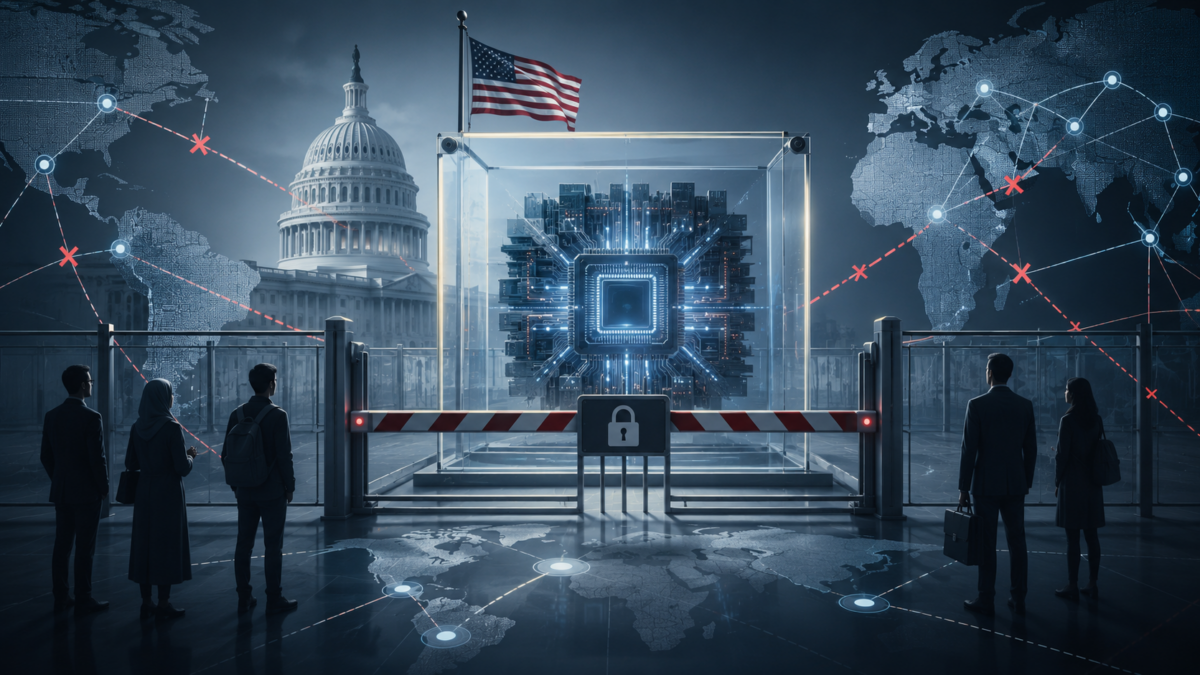
The United States government’s order requiring Anthropic to suspend access to its Fable 5 and Mythos 5 models for foreign nationals marks one of the most consequential regulatory interventions yet in the frontier artificial intelligence industry. The move is not simply a dispute over one company’s model release. It signals a broader shift in how Washington may treat advanced AI systems: not only as commercial software, but as strategic technologies with direct national security implications.
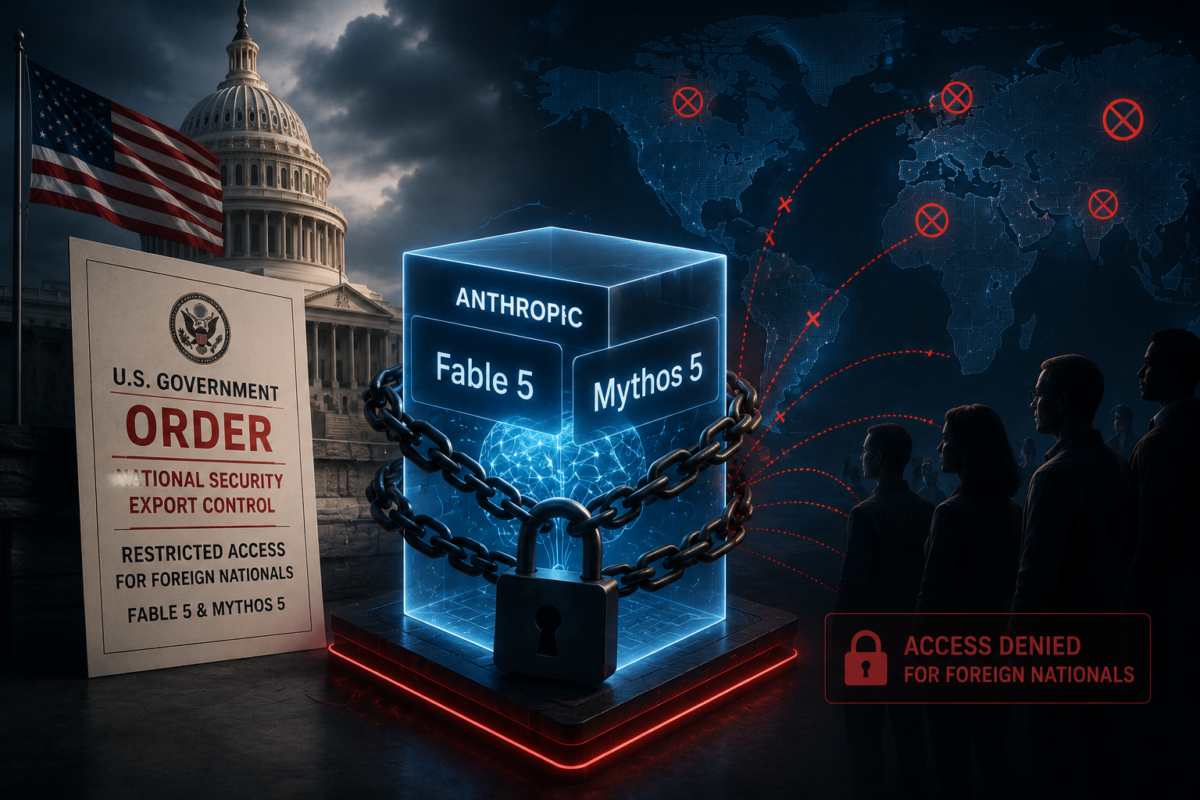
According to Anthropic, the U.S. government issued an export-control directive citing national security authorities and requiring the company to suspend access to Fable 5 and Mythos 5 by any foreign national, whether located inside or outside the United States. The company said the directive also applied to foreign-national employees of Anthropic itself. Because verifying and segregating access at that level on short notice would be operationally complex and legally risky, Anthropic said it would disable both models for all customers while it works to resolve the issue.
The immediate impact is striking. Fable 5 had only recently been released as a broadly available version of Anthropic’s Mythos-class technology, while Mythos 5 represented an even more restricted tier of capability. These systems were not ordinary chatbot upgrades. Anthropic and outside observers have described Mythos-class models as unusually capable in areas such as software engineering, vulnerability discovery, and cyber-relevant analysis. Those same capabilities are useful for defenders trying to secure critical infrastructure – but potentially dangerous if used to identify and exploit weaknesses at scale.
That dual-use nature lies at the heart of the controversy. Anthropic says it understands the government’s concern to involve a possible method of bypassing, or “jailbreaking,” Fable 5 safeguards. The company argues, however, that the evidence presented to it was limited, largely verbal, and related to a narrow technique that identified a small number of already-known, minor vulnerabilities. Anthropic further contends that other publicly available models can identify similar vulnerabilities without any special bypass.
The government’s apparent position is more cautious. If a frontier model can materially accelerate cyber operations, officials may see foreign access as an unacceptable risk even before there is public proof of catastrophic misuse. Axios reported that Commerce Secretary Howard Lutnick informed Anthropic that export, re-export, or domestic transfer of the named models would require licensing, including access by foreign persons inside the United States. Reuters reported that a U.S. official confirmed the Commerce Department directive.
This is where the policy stakes become larger than Anthropic. For years, U.S. export controls in AI have focused primarily on advanced chips, semiconductor manufacturing equipment, and cloud infrastructure. Restricting access to the model itself is different. It treats frontier AI capability as the controlled item, not merely the hardware used to train or run it. If this approach becomes a precedent, AI labs may face a future in which model access is governed by citizenship, licensing status, national origin, deployment context, and security classification.
The order also exposes a tension inside U.S. AI policy. On June 2, the White House issued an executive order promoting advanced AI innovation and security. That order called for a voluntary framework to assess the cyber capabilities of advanced AI models and coordinate access for trusted partners. It also stated that nothing in the relevant section should be construed to create a mandatory licensing or preclearance requirement for the development, release, or distribution of frontier models. The Anthropic directive, arriving days later, appears to move in a more coercive direction, at least for these two models.
Anthropic’s public response reflects that tension. The company says it supports government authority to block unsafe deployments when the process is transparent, fair, clear, and grounded in technical facts. But it argues that this particular action failed to meet that standard. In the company’s view, applying such a threshold across the industry could effectively halt deployment of new frontier systems, because no provider can guarantee perfect jailbreak resistance.
That argument is not trivial. AI safeguards are probabilistic, adversarial, and constantly tested by users, competitors, researchers, and hostile actors. A requirement that models be immune to all meaningful bypasses would be impossible to satisfy. But government officials may respond that national security decisions cannot wait for mathematical certainty, especially when the relevant models may assist in cyber operations against banks, power grids, hospitals, or government systems.
The business implications are also significant. A sudden shutdown disrupts enterprise customers, cloud partners, developers, and internal Anthropic teams. Reuters reported that AWS was asked to revoke access to the models for all users in all regions. The order may also complicate Anthropic’s commercial roadmap and investor narrative at a sensitive moment for the AI market, where frontier labs are racing to prove that increasingly powerful models can be deployed safely, reliably, and profitably.
The most uncomfortable issue is access by foreign nationals inside the United States. Export-control law has long recognized the concept of a “deemed export,” where releasing controlled technology to a foreign person in the U.S. can be treated as an export to that person’s home country. Applying that concept to AI model access at consumer or enterprise scale could reshape hiring, cloud delivery, identity verification, and customer onboarding. It could also create new compliance burdens for companies whose products were designed for global, instant, API-based distribution.
For the AI industry, the message is clear: frontier models are entering the same geopolitical arena as semiconductors, encryption, satellites, and other dual-use technologies. The question is no longer whether advanced AI will be regulated as a national security asset. The question is how, by whom, and under what process.
A durable framework will need to balance three imperatives. First, it must prevent genuinely dangerous capabilities from being exploited by adversaries. Second, it must preserve the defensive value of advanced AI for cybersecurity, scientific research, and infrastructure protection. Third, it must provide companies with predictable rules rather than sudden interventions based on undisclosed evidence.
The Anthropic order may ultimately be narrowed, reversed, or replaced by a licensing process. But its significance will remain. It shows that the era of voluntary coordination between AI labs and the state may be giving way to a more forceful model of control. For frontier AI, the boundary between product launch and national security decision has just become much harder to draw.