
GROUP STARLIGHT / AI FOR WELLNESS COMMERCE
NutriCommerce AI
AI for wellness online stores
Product guidance for customers. Sales insights for your team.
An AI consultant, intelligent search, recommendations and an internal CRM built around your company’s data. For stores selling supplements, healthy foods, juices and functional drinks.
From €5,000 / month During the first year.
Maintenance and support: €800 / month from the second year.
A tailored implementation by Group Starlight, not a plug-and-play chatbot.

CustomerI’m looking for a drink with no added sugar that I can take to work.
AI consultantDo you prefer fruit juice or a vegetable blend?
Business insight preview
Search coverageReview requests without suitable results
Product informationCheck recurring questions about pack sizes
Human reviewApprove proposed catalog improvements
- Dietary supplements
- Healthy foods & snacks
- Juices & functional beverages
- Wellness-oriented products
One platform for customers and your team
AI tools, website development and business software, connected around your store.
AI tools
A consultant, intelligent search and relevant recommendations help customers find and understand products.
Website development
Agreed improvements to product pages, filters and customer accounts connect guidance with the catalog and basket.
Business software
An internal CRM, demand analysis and evolving customer segments help your team act on evidence.
Selection is a business challenge
Where customer questions become commercial friction
Your store may face some of these challenges. We connect product discovery and customer assistance with information your team can act on.
Needs, not product names
Customers may describe what they want without knowing which product to search for.
A complex assortment
Similar ingredients, formats and price points can make comparison difficult.
Questions before checkout
Unclear composition, pack sizes, delivery or returns can delay a decision.
Search that misses intent
Exact-name searches can overlook useful products and relevant store information.
Repeated questions
Staff spend time answering the same product and policy questions.
Scattered insights
Searches and conversations contain useful signals that are difficult to review together.
Customer assistance
A product consultant built around your approved knowledge
We build a consultant that understands everyday questions, asks useful follow-up questions and explains verified product information. It helps customers move from a question to a product page and the cart.
Clarify the request
Ask about preferences, budget, format and relevant product constraints.
Explain and compare
Use approved catalog information to explain composition, formats and differences.
Help with the next step
Guide customers to product pages and the cart, and explain approved delivery and return policies.
Bring in a person
Transfer complex or unresolved questions to a member of your team.
CustomerI’m looking for a drink with no added sugar that I can take to work.
AI consultantDo you prefer fruit juice or a vegetable blend?
CustomerA vegetable blend, in a small bottle. Show me the options within my budget.
These fictional examples illustrate a catalog comparison. In your store, results would use verified product attributes and current availability.

Demo Garden Blend
Vegetable drink · No added sugar · Small bottle
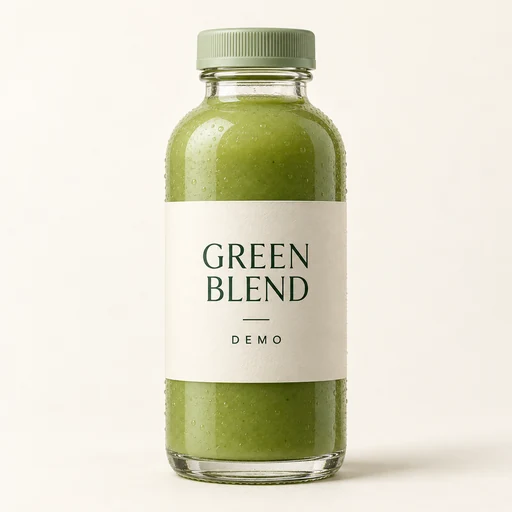
Demo Green Blend
Vegetable drink · No added sugar · Small bottle
AI-generated product photography. Fictional catalog examples, not products offered for sale.
Intelligent discovery
Search the way your customers think
A request such as “a small drink with no added sugar for my commute” can find relevant products and useful website content, rather than relying only on exact names.

Everyday language
Match synonyms, common spelling mistakes and conversational descriptions to your assortment.
Useful filters
Refine by category, composition, format, price and current availability.
Comparisons and alternatives
Explain meaningful differences and show relevant alternatives.
Unmet demand
Report searches without suitable results so the team can review catalog coverage.
Relevant next choices
Recommendations that respect the customer
The goal is to reduce selection friction and support useful additional and repeat purchases, not to push every customer toward a bigger basket.
Relevant alternatives
Suggest options that meet the same stated needs and budget.
Complementary products
Offer useful combinations and bundles where they make sense.
Shared preferences
Use preferences the customer has explicitly provided.
Repeat purchases
Suggest reorders from appropriate purchase history and current availability.
Demand and needs analysis
Learn from the questions your store receives
Alongside customer assistance, the platform can analyze appropriately collected store signals. This describes your store’s audience, not the entire market.
Requests and questions
Search queries, frequently asked questions, requested attributes and searches without useful results.
Store journeys
Product views, cart abandonment, purchases and repeat orders, where collection is appropriate.
Preferences and objections
Explicitly stated requirements and reasons for hesitation.
Commercial opportunities
Identify missing assortment coverage, unclear product information and opportunities to improve filters, pages and bundles.
Customer understanding
Evidence-based profiles, not fixed stereotypes
Customer profiles evolve as more appropriate company data becomes available. We do not infer diagnoses or health conditions from browsing behavior.
Purchase goals
Preferred categories, selection criteria and explicitly stated objectives.
Shopping patterns
Typical order value, repeat-purchase frequency and common objections.
Commercial context
Acquisition channels and customer value where sufficient economic data exists.
An internal business workspace
Customer context and decisions in one place
An internal CRM brings together customer records, orders, conversations, requests, segments, staff tasks, business reports and knowledge management.
Review commercial performance
Track conversion, order value, repeat purchases and returns against a baseline, accounting for seasonality.
Improve assistance
Review search relevance, answer quality, unresolved questions and staff workload.
Measure commercial value
Assess additional contribution margin after system costs where sufficient economic data is available.
Act on evidence
Each recommendation includes supporting observations, the reporting period, a suggested action and a task owner.
Company data and controlled learning
Your knowledge. A clearly agreed architecture.
Company information is stored in company-controlled infrastructure or a dedicated private environment. Employee roles control access, and different client companies’ data is isolated.

A corporate knowledge base
Product data and approved company materials provide the information the system retrieves when answering questions.
Live operational information
Prices, stock and order status come from connected systems, rather than being assumed from old training examples.
Reviewed improvements
Staff review learning examples and feedback before using them to improve the system. Model tuning is optional, not automatic.
Agreed data arrangements
Define employee roles, access logs, retention, backups and data export during implementation.
From assessment to ongoing development
Four stages, with quality checks along the way
The first year includes development and improvement within the agreed project scope. Milestones, acceptance criteria and a launch schedule are agreed after assessing your store, data and integrations.
Business and data assessment
Review your store, customer journeys, catalog quality, priorities and available data.
Knowledge and integration setup
Prepare the catalog, approved materials, connections and employee access.
Pilot and quality evaluation
Test useful customer journeys, answer quality, search relevance and human handover.
Development and handover
Measure and improve the solution, onboard your team and document support procedures. Ongoing maintenance starts in the second year.
A transparent project model
Development first. Ongoing support after.
Choose the scope around your store and commercial priorities. Final deliverables and service limits are agreed for each project.
During the first year
Development and implementation
From €5,000 / month
- Business and data assessment
- AI consultant and intelligent search
- Corporate knowledge base
- Internal CRM and core analytics
- Initial recommendation capabilities
- Agreed integrations and website improvements
- Team onboarding and iterative development
From the second year
Maintenance and support
€800 / month
- Monitoring
- Troubleshooting and correction of defects
- Security updates
- Backup checks
- Support for the implemented solution within agreed limits
Build on the foundation
Additional development when your business needs it
Work outside the agreed first-year scope is estimated separately. These capabilities are available on request, not automatically included.
Website improvements
Further storefront, checkout and performance improvements.
Mobile applications
Customer or staff apps matched to your workflows.
Accounts and loyalty
Customer accounts, loyalty features and repeat-order subscriptions.
Additional integrations
Extend connections to business systems and specialist services.
Partner portals
Distributor or partner tools with appropriate access.
Custom workflows
Tailored dashboards, tasks and functionality.
Questions before you start
Can this be integrated into our existing online store?
Yes, integration is assessed against your platform, catalog, business systems and available interfaces. We agree the practical scope before implementation.
What company data is needed?
Product descriptions, verified attributes, prices, stock data and approved policies are the starting point. Orders, search and customer-service signals may support additional capabilities where their use is appropriate.
Where is data stored?
In company-controlled infrastructure or a dedicated private environment, with access, retention, backup and export arrangements agreed for the project. External AI processing is disclosed in the architecture.
How does the system learn from company information?
It retrieves approved information from the knowledge base. Reviewed feedback and examples can improve quality; optional model tuning is assessed separately. Conversations do not automatically become training data.
Does the consultant provide medical advice?
No. It provides approved product information, not diagnoses, treatment recommendations or promises of therapeutic effects. Complex questions can be handed to a person.
Is sales growth guaranteed?
No. Better discovery, useful recommendations and faster answers are mechanisms intended to support conversion, order value and repeat purchases. Outcomes depend on the store, assortment, audience and execution.
What is included in the first year?
Development and iterative improvement within the agreed scope, starting from €5,000 per month. The commercial proposal defines deliverables, integrations, computing and other costs.
What changes after the first year?
Maintenance and support cost €800 per month from the second year, within agreed service limits. New functionality and larger changes are estimated separately.
Is a mobile application included?
No. A mobile application is available as additional development on request, with its own agreed scope and estimate.
Can we request custom functionality?
Yes. Additional integrations, workflows, loyalty features, portals and dashboards can be scoped and estimated for your business.
GROUP STARLIGHT
Let’s Discuss an AI System for Your Online Store
Tell us about your store and your main business goal. We can discuss the product, demonstrate the proposed workflows and assess a practical implementation scope.
Please do not include medical details, passwords or other sensitive personal information.